

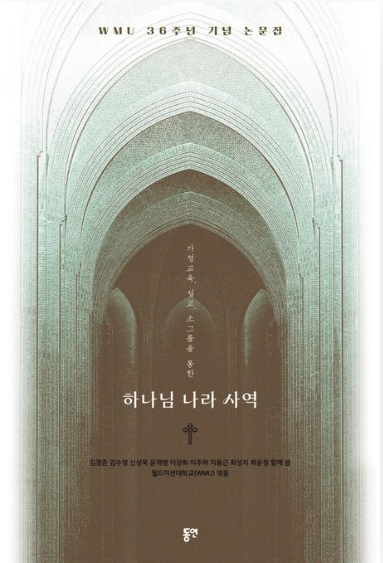
World Mission University Publishes 36th Anniversary Commemorative Volume on Kingdom Ministry through Family Education, Preaching, and Small Groups.
New Challenges Facing the Church in the Post-Pandemic Era
The world is undergoing intense upheaval. Amid the unprecedented transformation known as the “post-pandemic” era, we are witnessing a fundamental reshaping of the landscape of life and ministry. In the wake of the massive wave called the pandemic, an entirely different reality has emerged—one unlike anything we have known before.
Rapidly changing circumstances often confront us as a bewildering crisis, yet at the same time, they present a precious opportunity to redefine our mission. In the midst of these powerful historical currents, no matter how much the world changes, the guiding marker we must firmly hold on to—the vocation of the Church—becomes even clearer. That marker is the unchanging truth.
While cultivating a discerning awareness of the times, we must firmly anchor the essence of the Gospel at the center. On the one hand, we hold fast to the truth God has entrusted to us; on the other, we seek to deeply understand the concrete contexts of life in which we are situated, discerning how we are to live and minister within them. When these two dimensions meet, the Church can truly become a source of hope for this generation.
Today, standing upon the waves of change, we raise the anchor of our calling.
Author Information
Kyung Joon Kim
Pastor
Dr. Kyung Joon Kim serves as the Department Chair of the Doctor of Ministry in Counseling and Spiritual Formation (DMin-CC) program and Director of Information Services at World Mission University. He earned his M.A. from Chongshin University’s Graduate School of Missions and his M.Div. from Chongshin Theological Seminary. After immigrating to the United States, he completed an M.A. in Christian Counseling at Southwestern Baptist Theological Seminary and doctoral coursework in Clinical Psychology at Fuller Theological Seminary.
He served for nine years as a pastor overseeing family ministries at Choong Hyun Mission Church and previously directed both the Korean Christian Counseling Center and the Santa Fe Counseling Center. His academic interests focus on forgiveness-based healing and the integration of theology and psychology, and he has published research in these areas.
Dr. Kim is a Licensed Psychologist in the State of California and a Supervising Counselor with the Korean Evangelical Counseling Association. He currently operates Eleos Counseling Center, serves as a clinical supervisor for multiple counseling centers, and is President of the International Member Care Counseling Association.
Soo Young Kim
Theologian, Pastor
Dr. Soo Young Kim is the Senior Pastor of His Church in Los Angeles and an adjunct professor at Grace Mission University, where he teaches Greek, hermeneutics, and homiletics. He earned both his Th.M. and Th.D. (Bible Exposition) from Dallas Theological Seminary.
After returning to Korea, he planted Nanum Church and taught hermeneutics and preaching at Torch Trinity Graduate University. For many years, he led preaching clinics for Korean pastors and served as Editor-in-Chief of the monthly journal Expository Preaching.
After completing 22 years of ministry in Korea, he returned to the United States, where he continues to serve in pastoral ministry and theological education, including teaching at Azusa Pacific Seminary. His published works include Companionship in the Storm and With Wholehearted Devotion (Kyujang Publishing), and he has translated numerous theological works, including Worship and Spirituality (Allen P. Ross).
Sung Wook Shin
Professor, Theologian
Dr. Sung Wook Shin earned his B.A. in English Literature from Keimyung University and completed his theological studies (M.Div. Equiv.) at Chongshin Theological Seminary. He pursued Old Testament studies at Trinity Evangelical Divinity School and earned a Th.M. in New Testament studies from Calvin Theological Seminary. He later completed his Ph.D. in Homiletics at the University of Pretoria in South Africa.
A specialist in integrative biblical hermeneutics spanning both the Old and New Testaments, as well as rhetorical preaching, Dr. Shin is widely recognized for developing innovative frameworks for biblical and effective preaching and one-point dramatic expository preaching.
He conducts annual “Bible Syndrome” seminars and “One-Point Dramatic Expository Preaching” seminars both in Korea and internationally, contributing significantly to the training of skilled preachers. His publications include The Skill of Eating the Bible (Kyujang), as well as numerous other authored and translated works, including John MacArthur’s The Truth War (Word of Life Press).
Jae Byung Yoon
Pastor, Professional Coach
Dr. Jae Byung Yoon is a professional coach and pastor dedicated to cultivating mission workers through creative development and coaching, and to building communities that practice compassion for humanity (HDC). He studied English Literature at Ajou University and earned his M.Div. from Hapdong Theological Seminary, followed by a D.Min. in Missional Pastoral Leadership and a Doctor of Global Leadership (DGL) from Fuller Theological Seminary.
He currently serves as Director of the Masterpiece Coaching Institute (MCI), a Professional Certified Coach (PCC) with the International Coaching Federation (ICF), and a Supervising Coach (KSC) with the Korea Coach Association. He also teaches doctoral students as an adjunct professor of Coaching Studies at World Mission University.
The “Grace-Based Small Group Coaching” (GSC) model proposed in this volume represents an integration of his pastoral experience and professional coaching expertise.
Sang Hwa Lee
Pastor
Rev. Sang Hwa Lee has served as Senior Pastor of Seohyun Church in Seoul since 2017 and is the Director of the Korea Small Group Ministry Institute, which he founded in 1994. He completed his academic training at Chongshin University (B.A., M.Div., Th.M., Ph.D. coursework) and Westminster Graduate School of Theology (Ph.D.).
He participated from its inception in the establishment of the Small Group Ministry degree programs (M.A., Th.M.) at Westminster Graduate School of Theology and served there as a professor for many years. He also served as a professor at Chongshin University’s Graduate School of Pastoral Theology.
Rev. Lee has held leadership roles in the Korea Christian Pastors Association and the Church Renewal Association and was the founding editor of Christianity Today Korea. He has also hosted FEBC Far East Broadcasting’s program “Church Outlook” for many years. His publications include Small Group Leadership for Healthy Church Growth and How to Build a Healthy Small Group Ministry, among many other works on small group ministry and pastoral leadership.
Ju Ha Lee
Professor
Dr. Ju Ha Lee teaches Introduction to Sociology and Human Behavior and the Social Environment at World Mission University. She earned her undergraduate degrees in Political Science and Economics from the University of Illinois and a master’s degree in Political Science from the University of Chicago. She later completed doctoral coursework in Sociology at the University of California, Riverside.
Her research interests focus on the physical and mental health of parents raising children with developmental disabilities, with particular attention to how social factors such as gender, race, and class contribute to health inequalities.
Yong Keun Ji
Pastor, Research Director
Rev. Yong Keun Ji is the Director of the Pastoral Data Research Institute and CEO of GNCom Research Inc. He earned his degree in Sociology from Yonsei University and previously served as Head of Research at Gallup Korea and CEO of Global Research Inc.
In 2019, he founded the Pastoral Data Research Institute, which publishes the weekly report Numbers, providing key social and statistical data free of charge to over 26,000 pastors and church leaders across Korea. Since 2022, he has served as the lead author of the Korean Church Trends series. His additional publications include Growing Churches, Declining Churches and The Korean Church Diagnostic Report.
Sung Ji Choi
Christian Educator
Dr. Sung Ji Choi earned her B.S. in Education from Baylor University and her M.A.C.E. and Ph.D. in Christian Education from Southwestern Baptist Theological Seminary. She has served as an educational minister focusing on children’s ministry in both Korea and the United States.
Currently, she serves in women’s ministry at LA East Sarang Church, where her husband is the senior pastor. She leads “Mothers in Prayer” (MIP) seminars and “Faith Time” Bible study groups, devoting herself to strengthening families and churches.
Yoon Jung Choi
Professor of Practical Theology, Theologian
Dr. Yoon Jung Choi is Professor of Practical Theology at World Mission University and currently serves as Vice President. She earned her B.A. from Hankuk University of Foreign Studies, her M.Div. from Presbyterian University and Theological Seminary, her M.A. from Fuller Theological Seminary, and her Ph.D. in Intercultural Education from Biola University.
An ordained Presbyterian pastor, she actively engages in creative ministries related to multiculturalism, diaspora studies, Christian education, and diakonia. She serves as an advisor to Human & Human International and leads 21st-century Christian education platform initiatives through the Pacific Center for Culture and Education (PCCE).
Her scholarly work includes Multicultural Education for 1.5 and 2nd Generation Korean-Americans, Identity Issues of Migrant Children and Christian Education, Churches Caring for Children from Migrant Backgrounds, Korean Immigrant Women in Hawaii, and Directions for Spiritual Education in the Online Era.
Edited by World Mission University (WMU)
World Mission University is a leading Korean-American Christian university located in Los Angeles, California. Through its online smart education system, WMU serves students throughout the United States and around the world. The university offers undergraduate, master’s, and doctoral programs in Christian Ministry, Christian Counseling and Coaching, Social Work, Nursing, Theology, Pastoral Studies, Counseling Psychology, Music, Global Leadership–Coaching, and Worship and Praise, as well as an active Spanish-language program serving as a strategic hub for Latin American missions.
Table of Contents
Foreword
-
Publishing This Volume — Sung Jin Lim
-
Words of Recommendation — Sang Myung Lee, Seung Hyun Lee
Preface
-
Preface — Sun Muk Shin, Yoon Jung Choi
Part I · The Church in an Age of Spirituality and Christian Education
Sung Ji Choi · Spirituality and Parenting Education from a Biblical Perspective
— Practical Worship Training for Daily Life that Builds the “Muscles” of Faith
I. Introduction
II. Defining Spirituality
III. Parents’ Spirituality (Relationship with God) and Child Education
IV. A Biblical Understanding of the Parental Role
V. Applications for Parents’ Spirituality and Child Education
VI. Conclusion
Ju Ha Lee · Christian Support and Its Impact on the Health of Parents Raising Children with Developmental Disabilities
I. Introduction
II. What Is a Developmental Disability?
III. Caregiving Theory
IV. Social Support: Religion
V. The Role of Religion
VI. A Christian Worldview on Disability
VII. A Christian Approach to Raising Children with Developmental Disabilities
VIII. Christian Resources and Their Impact on Caregiving Families
IX. Roles of the Church Community and Individual Believers, and Areas for Improvement
X. Practical Guidelines for Individual Believers
XI. Conclusion
Yoon Jung Choi · Cross-Cultural Experiences of Youth in Immigrant Churches
— A Christian Education Inquiry for Enhancing Intercultural Competence
I. Introduction
II. Experiential Learning Theory and Educational Foundations for Intercultural Learning
III. The Relationship Between Intercultural Competence and Intercultural Sensitivity
IV. Contexts of Diverse Cross-Cultural Experiences in Adolescence
V. Implications for Christian Education
VI. Conclusion and Suggestions
Part II · Preaching Strategies for a New Era and Mental Health Crisis Care
Soo Young Kim · “The All-Purpose 5W1H Principle” and Emphatic-Style Sermon Preparation
I. Introduction
II. Main Discussion
III. Inductive Approach or Deductive Approach?
IV. Conclusion
Sung Wook Shin · Strategies for Change in the Pulpit in the Post-Covid Era
— With a Focus on “Inductive Direction”
I. Opening Remarks
II. Main Body
III. Concluding Remarks
Kyung Joon Kim · The Role of the Church in Responding to Mental Health Crises
— Focusing on Reducing Stigma Effects and Mental Health Coaching Ministry
I. Opening Remarks
II. Main Body
III. Concluding Remarks
Part III · Small Group Ministry and Church Growth
Yong Keun Ji · Understanding Changes in the Church and Society After the Pandemic and the Future Direction of Small Group Ministry
— Centered on Survey and Statistical Data
I. Introduction
II. Changes in Contemporary Society and Characteristics of Korean Society
III. The Current State of Small Groups in the Korean Church
IV. Conclusion: Strategic Directions for Small Group Ministry
Sang Hwa Lee · Directions and Practices for Small Group Ministry Toward Healthy Church Growth
I. Opening Remarks
II. What Is a Small Group?
III. Why Small Group Ministry Matters After the Covid-19 Pandemic
IV. Practical Approaches and Directions for Healthy Church Growth Through Small Group Ministry
V. Closing Remarks
Jae Byung Yoon · Grace-Based Small Group Coaching
— Growth and Transformation in Church Small Group Ministry Through Grace-Driven Coaching
I. Introduction
II. Theological Foundations of “Grace-Based Small Group Coaching”
III. Core Principles of Grace-Based Coaching
IV. The GRACE-DRIVEN Coaching Conversation Model
V. Grace-Based Small Group Coaching Workshops
VI. Summary and Conclusion
Contributors / Author Notes
(Contributors list and biographical notes)
Endorsements
Sang Myung Lee (President, California Prestige University)
Even amid an era marked by de-religionization and turbulent anti-gospel currents, World Mission University faithfully holds fast to the truth of the Gospel and carries out its mission of raising Christian leaders who are devoted to the expansion of God’s Kingdom through education. I am confident that this volume will become yet another milestone in that calling, and I hope it will offer pastors, seminarians, and Christian leaders in local communities practical insight and a challenge that leads to growth.
This collection includes nine short academic essays that seek to explore, theologically and practically, real issues facing the church and society—such as children’s education, preaching, small group ministry, and mental health. These writings are not merely a list of scholarly accomplishments; rather, they bear the imprint of tears and prayers, insight and confession, from those who live and serve in the field of ministry.
Above all, each essay goes beyond theoretical discussion to offer practical alternatives, pursuing a healthy tension and harmony between theoria and praxis. Readers will gain a deeper understanding of the realities of church ministry and will sense the value of close solidarity through the authors’ scholarly passion and practical inquiry.
(From “Words of Recommendation”)
Seung Hyun Lee (President, International Theological Seminary)
This volume reflects well the academic depth and field-centered perspective of World Mission University. Each essay represents a sincere effort to seek practical solutions amid the complex circumstances the church faces today—covering topics such as education for children and parents, preaching in the post-covid era, small group ministry, mental health coaching, and the role of the church.
In particular, themes such as the relationship between the church and society after the pandemic and youth ministry in multicultural contexts will offer meaningful insight to those discerning future directions for ministry.
(From “Words of Recommendation”)
Selected Passages (From the Book)
From a theological perspective, a stable relationship with God is made possible through redemption in Jesus Christ and the help of the Holy Spirit, and it is sustained through a life of repentance and obedience. When parents continue in this journey of spiritual restoration and sanctification, they can also display the fruit of the Spirit—such as patience, love, and self-control—in the education of their children (Gal. 5:22–23). Therefore, when parents recover stability and authenticity in their relationship with God, child education also becomes healthy, enabling children to develop a stable relationship with God and to grow toward spiritual maturity.
(Part I · Sung Ji Choi, “Spirituality and Parenting Education from a Biblical Perspective”)
Christianity should interpret caregiving not merely as an obligation, but as a calling and an opportunity to serve. Caring for the vulnerable is itself service offered to God, and the Christian faith enables parents to understand the process of raising children—and the church community’s care for such families—as a spiritual journey. In other words, believers are called to embody God’s will in the everyday realities of caregiving. In conclusion, the Christian faith is a multilayered resource for caregiving families, providing not only emotional and spiritual support but also meaning in life and a sense of belonging within a community. It is necessary to clarify how the church can concretely practice love and mercy for caregiving families on the basis of Scripture.
(Part I · Ju Ha Lee, “Christian Support and Its Impact on the Health of Parents Raising Children with Developmental Disabilities”)
In immigrant churches, intergenerational faith exchange and language-and-culture education through Korean schools can be sufficiently understood as important contexts for intercultural education. The parent generation provides children with roots of identity so that they may live as healthy citizens in immigrant society; the younger generation reinterprets these roots within the mainstream culture and forms new cultural and faith identities. Through this process, adolescents can cultivate intercultural sensitivity and grow into citizens with cultural competencies suitable for a global age.
(Part I · Yoon Jung Choi, “Cross-Cultural Experiences of Youth in Immigrant Churches”)
A simple sermon outline with three main points is derived from the 5W1H principle. By using 5W1H, one can develop an outline that preserves the flow and central idea of the biblical text. Of course, this requires ongoing training in observing the text’s flow and core message and building outlines accordingly. The central idea of the text must be a single sentence that encompasses all three points. “With God’s help, if we endure trials well, our character and relationships mature.” Ultimately, through trials we come to recognize God’s craftsmanship in shaping a person. Beyond that, there is God’s plan to bless a family or community. Even when it is not visible at the time, it becomes evident as time passes. The key is to preserve this overall flow while clearly expressing what each point seeks to convey—maintaining unity and thrust while also honoring the richness of the particulars. If one emphasizes only the points, unity is lost; if one emphasizes only unity, the richness of each point may be diminished. Training that holds both together is essential.
(Part II · Soo Young Kim, “The All-Purpose 5W1H Principle and Emphatic-Style Sermon Preparation”)
Among the homiletical alternatives for the endemic era, one indispensable element is innovation in the system of delivery. As is well known, Korea’s traditional deductive, point-based preaching has strengths in settings such as dawn prayer services or funeral sermons, where religious sensibilities are heightened. … In keeping with today’s inductive cultural flow, preachers must equip themselves with various sermon forms beyond the traditional deductive “three-point” preaching. For example, it is important to appropriately utilize a one-point sermon approach centered on a single theme.
(Part II · Sung Wook Shin, “Strategies for Change in the Pulpit in the Post-Covid Era”)
In contemporary society, the church’s ministry in responding to mental health issues is becoming increasingly important. Yet the first question to consider is whether such mental health care ministry theologically aligns with the church’s original mission and role. Historically, the functions of the church have focused primarily on gospel proclamation, administration of the sacraments, and the nurturing of believers. However, with the growing need for inner healing and mental health care, a new ministry domain has emerged. For this development to be sustainable, its validity must be examined on the basis of a healthy theological ecclesiology.
To that end, we may consider the functions of the church as presented by Millard J. Erickson, a well-known evangelical systematic theologian. Erickson broadly identifies four functions of the church and explains its nature and mission theologically: evangelism, edification, worship, and social concern.
(Part II · Kyung Joon Kim, “The Role of the Church in Responding to Mental Health Crises”)
In summary, in an era of accelerated individualism and disconnection following the pandemic, statistical data confirms that the church can restore genuine community through small groups, heal loneliness and alienation among believers, and revitalize spiritual growth and evangelistic vitality. Small groups must no longer be treated as an optional program; rather, they should become an essential core strategy for responding to the demands of contemporary society and fulfilling the church’s fundamental mission.
(Part III · Yong Keun Ji, “Understanding Changes in the Church and Society After the Pandemic and the Future Direction of Small Group Ministry”)
Clinically speaking, in order to establish a direction for small group ministry that promotes healthy church growth, it is crucial to begin with a healthy ecclesiology. Without a sound understanding of the church—where Christ is the head and all believers are interconnected members, with both organizational and organic dimensions—a small group structure driven merely by command-and-control hierarchy or by a biased ecclesiology can instead rigidify the entire church.
(Part III · Sang Hwa Lee, “Directions and Practices for Small Group Ministry Toward Healthy Church Growth”)
Grace-based coaching utilizes general coaching theories, but it focuses on facilitating the growth and transformation of individuals and small groups on the foundation of God’s grace. Empathic listening, reflective questions, encouragement and support, establishing action plans aligned with goals, and applying the grace-based coaching conversation model are key components. Through these elements, small group leaders can effectively help members grow spiritually and experience life transformation. Such coaching is not merely a technical approach; it must be practiced on the basis of God’s grace, seeking guidance through prayer, faith, and the leading of the Holy Spirit.
(Part III · Jae Byung Yoon, “Grace-Based Small Group Coaching”)
Publisher’s Review
This volume contains nine short academic essays that explore theologically and apply practically the pressing issues facing the church and society—such as children’s education, preaching, small group ministry, and mental health.
Part I addresses “The Church in an Age of Spirituality and Christian Education,” including: Sung Ji Choi, “Spirituality and Parenting Education from a Biblical Perspective”; Ju Ha Lee, “Christian Support and Its Impact on the Health of Parents Raising Children with Developmental Disabilities”; and Yoon Jung Choi, “Cross-Cultural Experiences of Youth in Immigrant Churches.”
Part II explores “Preaching Strategies for a New Era and Mental Health Crisis Care,” featuring: Soo Young Kim, “The All-Purpose 5W1H Principle and Emphatic-Style Sermon Preparation”; Sung Wook Shin, “Strategies for Change in the Pulpit in the Post-Covid Era”; and Kyung Joon Kim, “The Role of the Church in Responding to Mental Health Crises.”
Part III focuses on “Small Group Ministry and Church Growth,” including: Yong Keun Ji, “Understanding Changes in the Church and Society After the Pandemic and the Future Direction of Small Group Ministry”; Sang Hwa Lee, “Directions and Practices for Small Group Ministry Toward Healthy Church Growth”; and Jae Byung Yoon, “Grace-Based Small Group Coaching.”
Founded in March 1989 with a clear vision rooted in evangelical Protestant convictions, World Mission University has sought to educate ministers who integrate spirituality and intellect. Over the past 36 years, WMU has grown into a global educational community serving the church and the world. Through online education, WMU serves not only Korean diaspora communities worldwide, but also English-speaking ministers in Africa and Spanish-speaking church leaders, functioning as a strategic bridgehead for missions in Latin America. WMU continues to fulfill its mission by raising leaders across diverse fields, including theology, counseling, coaching, music, nursing, social work, worship, and global leadership.
This academic volume, published in commemoration of WMU’s 36th anniversary, represents a meaningful outcome that reflects the university’s identity and educational direction. It is our hope that it will become a valuable fruit that offers all of us the power of reflection and the courage to put insights into practice.
Basic Information
-
ISBN: 9788964470701
-
Publication Date: December 19, 2025
-
Pages: 384
-
Dimensions: 153 × 224 × 25 mm
-
Weight: 717 g
-
Format: Single volume (1 book)