

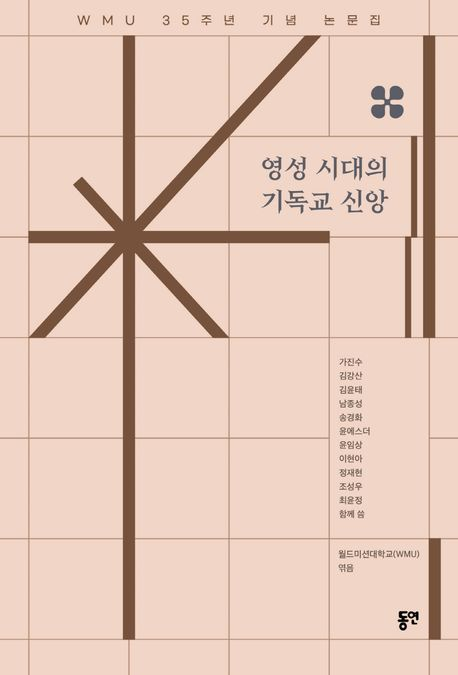
Thinking About the Age of Spirituality and the Reason for the Christian Church’s Existence
The greatest characteristic of today’s era can be described as rapid change. The emergence of AI and the metaverse is leading the future into a new world. Simultaneously, we are experiencing spiritual emptiness and an identity crisis.
The theme of “spirituality” is not limited to individual faith but is emerging as an important discourse that shapes the values of communities and society. Spirituality is extremely important in forming the values of communities and society, beyond being confined to personal belief.
This book is a collection of theses that seek creative and practical ways to form faith for the next generation, including children and Gen Z in Korean and Korean-American families. Eleven authors propose the process of forming spirituality for the next generation through diverse topics such as children’s worship, children with trauma, home education for Korean-American Gen Z, faith formation for children with disabilities, the identity of Korean immigrant youth in the US, preaching styles, ministry suitable for the era of the metaverse and artificial intelligence, and classical music.
◈ Authors/Editors
-
Jin-soo Ka: Chair of the Department of Worship Studies at World Mission University, President of GloWorship Ministries.
-
Kang-san Kim: Associate Pastor at New Jersey Chanyang Church, Independent Researcher.
-
Yun-tae Kim: Director of the Ph.D. Program in Ministry and Mission at World Mission University, Senior Pastor of Daejeon Sinseong Church.
-
Jong-seung Nam: Dean of Undergraduate Studies at World Mission University, Director of the Asian-American Spirituality Center.
-
Kyung-hwa Song: Chair of the Graduate School of Counseling Psychology at World Mission University, Director and Supervisor of the Korean Christian Counseling Center.
-
Esther Yoon: Director of the Doctor of Musical Arts Program at World Mission University, Instructor at California Arts Academy-San Gabriel Valley.
-
Im-sang Yoon: Chair of the Music Department at World Mission University, Artistic Director and Conductor of the LAKMA Philharmonic Orchestra & Choral.
-
Hyun-ah Lee: Professor of Social Work at World Mission University, Director of the Well-Tech Collaboration Center, Director of the DS Rim Foundation.
-
Jae-hyun Jung: Former Distinguished Professor at World Mission University, currently Special Appointment Professor in the Office of Academic Affairs at Yonsei University.
-
Sung-woo Cho: Ph.D. from Graduate Theological Union, Berkeley, Pastor in charge of the English Ministry at Bethany Presbyterian Church (PCUSA).
-
Yun-jung Choi: Vice President of World Mission University, Director of PCCE.
Editor: World Mission University World Mission University (WMU) is a prestigious Korean Christian university located in Los Angeles, USA. Students study here from the United States as well as from all over the world. The undergraduate program includes degree programs in Christian Ministry, Christian Counseling, Music, Nursing, and Social Work. The graduate school offers programs in Divinity, Theology, Global Leadership (majors in Welfare Mission and Coaching), Counseling Psychology, Music, and Praise and Worship. The doctoral program offers Doctor of Ministry and Doctor of Philosophy degrees. School Website: https://kr.wmu.edu / Phone: USA 213-388-1000
◈ Table of Contents
Foreword _ Sung-jin Lim
Part 1 ╻ The Age of Spirituality, the Church, and Christian Education Introduction _ Yun-jung Choi
-
Jin-soo Ka ╻ Modern Churches and Children’s Worship: Practical Life Worship Training that Builds Spiritual Strength I. Introduction / II. Modern Churches and Children’s Worship / III. The Essence of Worship and the Recovery of Spirituality / IV. Growing as a Worshiper of Life / V. Conclusion
-
Kyung-hwa Song ╻ The Role of the Church in the Prevention and Healing of Childhood Complex Trauma I. Introduction / II. Childhood Complex Trauma / III. Intervention for Childhood Complex Trauma / IV. Conclusion
-
Esther Yoon ╻ Education and Worship for Gen Z Children in Korean-American Families I. Introduction / II. Definition and Understanding of Gen Z / III. Education for Children in the Gen Z Era / IV. Gen Z and Worship / V. Conclusion
-
Hyun-ah Lee ╻ The Role of the Church and Home in the Faith Formation of Children with Disabilities: Focusing on Family Worship I. Introduction / II. Main Body / III. Conclusion
-
Yun-jung Choi ╻ Identity Issues of Youth in Korean Immigrant Families in the US and Christian EducationI. Introduction / II. Identity Development in Adolescence / III. Identity Status in Adolescence / IV. Factors in the Identity Formation of Immigrant Youth / V. Racial & Cultural Identity Development Model / VI. Christian Educational Approach to Identity Development / VII. Conclusion
References for Part 1
Part 2 ╻ The Age of Spirituality, Preaching, and Ministry Introduction _ Jong-seung Nam
-
Kang-san Kim ╻ Homiletical Theology for “Deconstructing the Marginalized Self”: A Proposal for Restructuring the Homiletical Theology of Korean Immigrant Churches I. Introduction / II. The Current State of Homiletical Theology in Korean Immigrant Churches: Mass Production of the Marginalized Self / III. Limits of Homiletical Theology in Korean Immigrant Churches: Theological Response to the Marginalized Self / IV. Deconstructing the Marginalized Self: Rediscovering “Us” / V. Homiletical Theology for Today: Preaching as Lament / VI. Conclusion
-
Jong-seung Nam ╻ Hermeneutics of Reframing: Biblical Hermeneutics for Preaching I. Introduction / II. History of Homiletics / III. Trends in Modern Preaching / IV. History of Biblical Interpretation / V. Biblical Hermeneutics for Preaching / VI. Hermeneutics of Reframing / VII. Conclusion
-
Jae-hyun Jung ╻ From Context to Word: For More Effective Preaching I. Introduction: The Reversal of Word and Context and its Necessity / II. Adjusting the Position of the Audience Required by the Shift in the Zeitgeist / III. Designing Sermons through Hermeneutics that Connect Faith to Life, Not Knowledge / IV. Conclusion: Preaching as an Encounter Shared with Life’s Questions
-
Sung-woo Cho ╻ A Study on Effective Preaching Styles: Focusing on the Four-Page Sermon, Preaching from Conflict to Resolution, and Plot and Move Preaching I. Introduction: Why Do We Focus on Sermon Forms? / II. A Brief Overview of the History of Preaching: Focusing on Homiletical Styles / III. Pros and Cons of Sermon Forms: Classical and New Preaching Paradigms / IV. Toward Effective Homiletical Communication / V. Practical Steps: Actual Sermon Examples According to Each Preaching Style / VI. Conclusion
-
Yun-tae Kim ╻ Reconsidering and Responding to Ministry and Missions in the Era of Metaverse and Artificial Intelligence I. Introduction / II. Understanding the Metaverse and Artificial Intelligence / III. Prospects and Challenges of the Metaverse and Artificial Intelligence in Ministry and Missions / IV. Responses to Ministry and Missions in the Metaverse and AI Era / V. Reconsidering Ministry and Missions in the Metaverse and AI Era / VI. Conclusion
-
Im-sang Yoon ╻ Rediscovery of Classical Music for Modern Worshipers: Focusing on Requiem by Latin Texts and Brahms’ A German Requiem (Ein deutsches Requiem) I. Introduction / II. Understanding the General Requiem / III. Brahms’ <A German Requiem> (Johannes Brahms, 1833–1897, Ein deutsches Requiem, Op. 45) / IV. Conclusion
References for Part 2 Editor / Author Biographies
◈ From the Text
The civilization and culture of the world today are entering the smart era and the Artificial Intelligence (AI) era at a very rapid pace and continue to develop. We live in an era where nothing is missing and nothing is impossible. However, the church possesses a powerful strength that the world cannot give, and that is the “Spiritual” aspect. Many parts of the church can be created and filled by the world, but the spiritual part cannot be filled no matter how much the world develops. If so, how is the “spirit” formed and how can spiritual power be developed? It is only through worship. Spiritual power is created through the elements of worship: the Word, prayer, and praise. Spiritual power cannot be created or filled through anything else. Therefore, worship is the important essence of the church and becomes the source that allows other church ministries to be produced and developed. — From <Modern Churches and Children’s Worship> by Jin-soo Ka
Considering that complex trauma “occurs chronically and repeatedly in situations where escape is difficult or impossible,” the home where children and adolescents are raised cannot be excluded. As minors, children and adolescents cannot easily “escape” the home regardless of what happens within it. While abuse or neglect occurs at home, experiencing seemingly minor things—such as contemptuous language or atmosphere, cold and strict parents who do not empathize, parents who are stingy with praise and recognition and instead criticize, perfectionistic or controlling parents, the absence of parents, parental conflict or domestic violence, comparison, disregard, or favoritism—repeatedly and chronically also results in complex trauma with serious aftereffects. Roberto Assagioli, the founder of Psychosynthesis, used the term “original wound” to describe the experience of not being accepted and loved for one’s existence and receiving unempathetic treatment, stating that the original wound can be the cause of various psychopathologies. This is also similar to the symptoms of complex trauma caused by the chronic experience of non-acceptance and lack of empathy in the home over many years from childhood. — From <The Role of the Church in the Prevention and Healing of Childhood Complex Trauma> by Kyung-hwa Song
Currently, the population of people with disabilities in the US is 45 million, of which approximately 3 million are children with disabilities. This figure accounts for 4.3% of the population under the age of 18, an increase of 0.4% from 2008 (as of 2019). Among children with disabilities between the ages of 5 and 17, the most common type was cognitive difficulty, followed by independent living difficulty, which was the second highest rate (though this applies only to children aged 15–17). This disability affected nearly 300,000 children with disabilities who had difficulty handling tasks alone, or 2.4% of this entire age group. Furthermore, 1.2% of children with disabilities aged 0–17 had two or more types of disabilities, a figure that accounted for more than a quarter of children with disabilities in 2019. Certain combinations of disability types were particularly common; for example, 88% of children who had difficulty with self-care also had difficulty with independent living, and 82.2% experienced cognitive difficulties. — From <The Role of the Church and Home in the Faith Formation of Children with Disabilities> by Hyun-ah Lee
Where should a sermon begin? One might ask why such an obvious question is being asked. In fact, many preachers prefer expository or exegetical preaching and start their sermons from the Scripture. It seems to be a conviction that when representing and proclaiming the Word of God, one should naturally start with the Bible, which is the Word of God. Then, what is the Bible? It goes without saying that the Bible is first and foremost the “Word of God.” Of course, this expression is correct as a metaphor. However, we think of it not just as a metaphor or simile, but as a literal statement. However, the raw materials adopted as the canon of the Bible were passed down orally for a long time by communities including prophets, seers, disciples, and apostles, and only much later became fixed in writing. But did God only write the Bible? Nature, as well as man-made objects, are God’s creations, so everything is something God made and wrote. Of course, God’s creation is not a mechanical manufacture. It is not one-sided but involves a role of giving and receiving. The Bible is no exception. Look at the Bible. It is an encounter! The encounter is the experience, the experience brings in interpretation, and within that interpretation, there is the Word that we “heard,” and it also contains our response and confession to that Word. — From <From Context to Word> by Jae-hyun Jung